
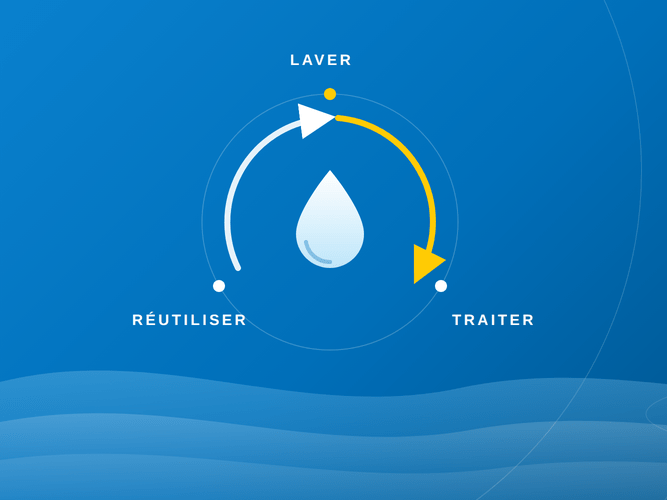
Part 1 – Background
Reducing water consumption is no longer an option
Summer 2026 has shifted the water resource from environmental to production constraint. For food, cosmetics and pharmaceutical manufacturers, the answer is at the washing station level to save water.
July 2026 will remain in the French climate annals. With an average temperature of 24.9 °Ceither +3.8 °C above normal 1991-2020, it is the warmest month ever measured in France since 1900. S
The administrative translation was immediate: at the height of summer, Almost 70% of metropolitan territory was under prefectural water restriction order. For a production site, this means a imposed reduction in water consumption, applicable within three days, regardless of the order book.
« By 2030, global water demand will exceed available resources by 40%. The aim is to improve water efficiency by 10% in the European Union by 2030. »
EUROPEAN WATER RESILIENCE STRATEGY — EUROPEAN COMMISSION
Water sobriety: a constraint that has become permanent
The Water France sets a course for -10% by 2030, in line with the European water efficiency objective. According to SDES, France collected 29 billion m3 of fresh water in 2023, down 12% in 10 years. The trajectory is set and will not be reversed: every summer dry tightens.
Washing the production equipment used to manufacture beauty products, medicines or food is the first water consumption station and the only one on which we can act without affecting production.
So the question is never to wash less. It is wash with much less water, and qualitatively: wash the residue of creams, oils, powder, sauce, chocolate ..
LWater saving is directly pilotable thanks to the washing machines MONTANIER.
-
+3.8 °C
Temperature anomaly in July 2026: warmest month since 1900
Source: Weather-France
-
−70 %
Precipitation deficit in July 2026, 3e July least watered since 1900
Source: Weather-France
-
16 j
Duration of heat wave from 4 to 19 July 2026
Source: Weather-France
-
~70 %
From restricted territory to the fort of summer
Source: VigiWater · summer 2026
-
−10 %
Target to reduce removals by 2030 (Water Plan)
Source: Water · France
-
−80 %
New water saving on a station equipped with a CYCLA recycling module
Treatment and recycling of industrial washing water (new tab) →
Source: Montanier
Part 2 – Regulatory framework
Water restrictions and ICPE: what drought imposes on your site
Drought decrees are not limited to garden watering. The Ministerial Decree of 30 June 2023 specifically covers classified installations (ICPE) subject to authorisation or registration whose annual levy exceeds 10 000 m3.
The reductions shall be calculated on the average daily reference sample. Only certain uses related to the safety and integrity of installations may be excluded from the calculation.
-
Level 1 — Vigilance
Awareness raising
No reduction imposed. Consumption monitoring: the only window to act calmly on its process.
-
Level 2 — Alert
−5 %
Mandatory reduction of water abstraction, applicable within three days after publication of the prefectural order.
-
Level 3 — Enhanced alert
−10 %
At this stage, manual jet cleaning, not measured and not reproducible, becomes very difficult to maintain.
-
Level 4 — Crisis
−25 %
A site that has not automated its cleaning has only one adjustment variable: slow down its production.
REGULATION — RETIREMENT AND USE OF WATERS
The Decree No. 2023-835 of 29 August 2023 laid down the general framework for the use of rainwater and treated wastewater (REUT). Moreover, the Decree No. 2024-33 of 24 January 2024, supplemented by the decree of 8 July 2024, regulates the water reused in food enterprises. Finally, the Decree No. 2024-796 of 12 July 2024 opens up the use of water unfit for human consumption for washing soil and outdoor surfaces. These uses remain subject to risk analysis and an authorisation or declaration procedure.
The lock is no longer regulatory: it is technical and it has been Montanier's profession for 50 years.
To go further on alternative resources, see our article dedicated to recycling of rainwater and industrial grey water.
Part 3 – Diagnosis
Cleaning: the place where you use water
-
Food
Mass volumes, high rates
Cleaning and disinfection concentrates a majority of water withdrawals from an agri-food site. Trays, palox, crates, drums, IBC-GRV, production lines: the volumes washed daily make each litre saved immediately significant on a year-wide scale.
Our washing solutions:
- Water efficient and efficient washing machines
- Recycling of washing water between two cycles
- Cleaning in place (NEP/CIP) controlled rather than timed
- Compliance of industrial releases
-
Cosmetics · Pharmaceuticals · Medical
The water is precious, let's protect it!
In Life Science, the water that comes to the washing station has been softened, osmosised, controlled and often heated. Purified water is very often used. Each litre saved is a litre that has not been produced, treated or rejected. Investing in a MONTANIER washing machine allows a good CSR approach and a faster return on investment (ROI), which unfortunately is not always calculated.
Our washing solutions:
- Parametric, controlled and repeatable cycles
- Washing of utensils, hoses, drums, IBCs, moving vats and washing machine parts
- Automatic dosage of your detergents for better control of their consumption
- Full traceability for quality audits
| Criteria | Manual jet washing | Montanier washing machine |
|---|---|---|
| Water volume per cycle | Not measured, depends on the operator | Fixed, parameterized and reproducible volume |
| Water reuse | None, direct rejection | Water treatment, recycling, reuse |
| Hygiene result | Variable according to gesture and fatigue | Constant, valid, recorded |
| Traceability | None | Historicalized cycle parameters |
| Operator exposure | Aerosols, detergents, high pressure lance | Closed speaker, high loading |
| Drought cessation | No margin: slow production | Real margin, demonstrable supporting figures |
Part 4 – Our solutions
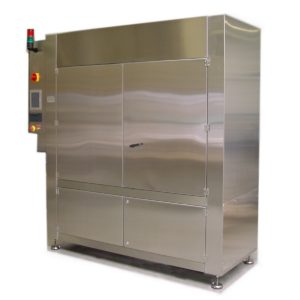
Montanier washing machines are designed to wash with less water
It is not a particular machine: it is the design principle of all our equipment. For 50 years, each solution we manufacture has the same objective: a validated hygiene result, with the lowest water volume possible.
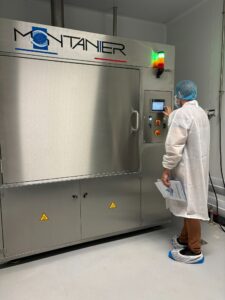
Allows Wash utensils of your productions and ensure an impeccable hygienic quality.
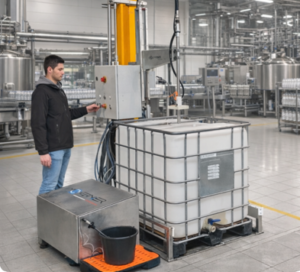
Rotary head High pressure Impacts the entire inner surface of theIBC/GRV : short cycle, reproducible and water flow much less than a jet wash.
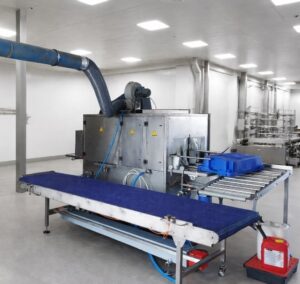
Wash bins and palox
A quick and impeccable washing quality for your palox, pallets, Containers, ..
Part 5 – To go further
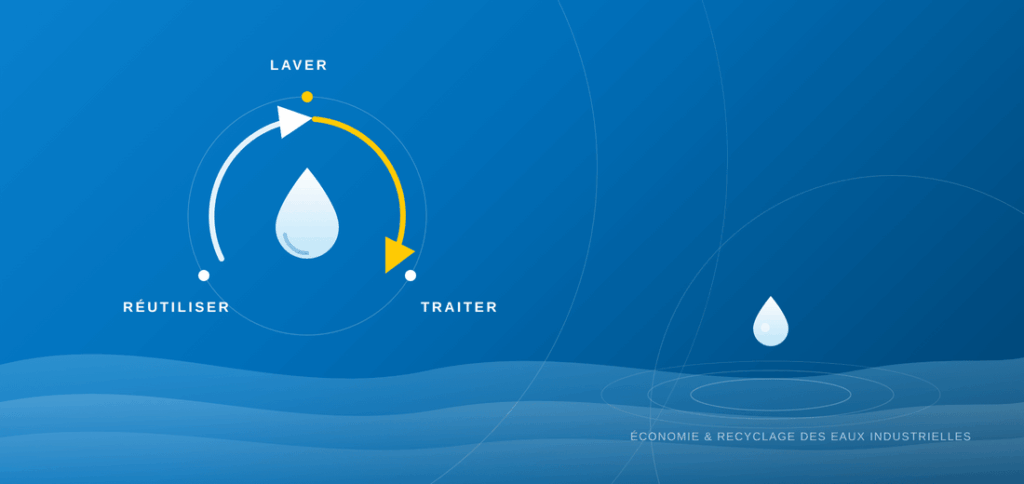
Reducing consumption is the first step. The second is to process and then reuse the water you already consume and that is where the return on investment accelerates.
Modules CYCLA Montanier treat your washing water and inject them back into your process. Separating sludge and hydrocarbons, automated multilayer filtration, continuous UV-ray disinfection, activated charcoal and antibacterial agent: water returns to the level of quality your use requires.
Available as an aboveground version or containerized, the recycling station installs without civil engineering on an operating site, a decisive point when production is not possible.
Consume less, then reuse what is consumed: this is how a site passes to pilot.
UP TO 80% ECONOMIZED WATER
Part 6 – A CSR approach
An ecological and responsible approach
Automate the cleaning results in effects that are not listed in a quote, but that are measured daily by industrial and HR directorates.
- Ergonomics
- Loading at the height of a man, end of the wearing of heavy loads and binding postures over a ferry.
- TMS
- Removal of repetitive brushing gestures and prolonged holding of a high-pressure spear.
- Productivity
- During the cycle, the operator is reassigned to a value-added task instead of remaining at the washing station.
- Health of employees
- Closed speaker: more exposure to aerosols, detergent projections and jet noise.
- Turn-over
- A heavy washing station is a difficult job to fill: automating it makes the organization more reliable.
Part 7 – Our approach
Accompaniment from end to end
Fromaudit your water consumption until maintenance A dedicated contact person analyses your needs in your specific environment.
-
01
Audit & diagnostic
Cartography of consumption by post, characterization of your water, identification of economic deposits.
-
02
Custom design
Size of the machine and recycling loop according to your containers and hygiene requirements. ROI encrypted.
-
03
Manufacturing & commissioning
French manufacturing, installation by our teams, operator training and performance validation.
MONTANIER intervenes in France and internationally.
-
04
Maintenance & Monitoring
Maintenance contract your fleet of machines, tracking saved volumes and regulatory watch.
Frequently Asked Questions
Industrial water consumption: your questions
Does a drought stop really apply to industrialists?
Yes. The Ministerial Decree of 30 June 2023 applies to classified installations (ICPE) subject to authorisation or registration with an annual levy exceeding 10 000 m3. It requires a reduction of the levy by 5% on alert, 10% on enhanced alert and 25% on crisis, calculated on the average daily reference levy. The prefectural order applies within three days.
How to reduce water consumption on an agri-food site?
The main lever is at the cleaning station, which concentrates most of the volumes. Four actions give quick results: replace manual jet washing with a closed machine with a fixed and parameterized cycle volume, automatically dose detergents, recycle washing water between two cycles, and measure shift consumption. A water audit is used to quantify the achievable gain on each of these actions.
Can you legally reuse your washing water in the industry?
Yes, in a framed setting. Decree No. 2023-835 of 29 August 2023 lays down the general framework for the reuse of treated wastewater. Decree No. 2024-33 of 24 January 2024 and the decree of 8 July 2024 regulate water reused in food enterprises; Decree No. 2024-796 of 12 July 2024 opens the use of water unfit for human consumption for the washing of soil and external surfaces. These uses remain subject to a risk analysis and an authorisation or declaration procedure.
How much water can we really save?
The gain is built in two stages. First of all the reduction at source, replacing an uncontrolled washing with equipment whose volume per cycle is fixed and parameterized. Then recycling: a CYCLA Montanier module treats the washing water and injects it back into the process, with up to 80% new water saved on the station concerned. The exact figure depends on the nature of the dirt, the level of hygiene targeted and the rate.
How long does a washing project take, from audit to commissioning?
The standard run consists of four stages: water audit and diagnosis, definition of the washing machine, manufacturing and commissioning, and maintenance and monitoring of saved volumes. The duration depends on the perimeter selected and the level of customization. A first exchange allows to specify it quickly.
Consult the Montanier washing machines
Our washing equipment
Water treatment and recycling
By sectors and services
Secure your production against water restrictions
Our experts map your consumption by post, encrypt the achievable gain and return on investment. First exchange without commitment.



