In the service of transport professionals, MONTANIER designs, manufactures, installs and maintains washing stations for buses, trams and heavy goods vehicles, capable of combining efficiency, robustness and control of operating costs. Each installation is designed to fit into your repository, meet your paces and simplify the daily work of your teams. From implantation to maintenance, our specialists support the design, manufacturing, installation, adjustment and commissioning of solutions suitable for your vehicles.
Our range covers all fleet washing: automated washing tunnels for standard and articulated buses, tunnels dedicated to trams, lava-chassis at the parade with fixed ramps and high-pressure wash-chassis with rotary heads. Our technologies optimize water and energy consumption, especially through the recycling of washing water.
Whether you want to create a washing station, upgrade existing equipment or improve the washing quality of your fleet, discover our solutions below.
The tunnel is suitable for standard 13-metre buses as well as 19-metre articulated buses.
A complete wash cycle :
- Prewetting with detergent
- Roof washing
- Brushing on all four sides
- Rinse
Cycle time and rate
- Standard bus 12 m : 1 minute
- 18 m and 24 m articulated bus: 1 minute 30 – 2 minutes
- Capacity: up to 30 to 40 vehicles per hour
Controlled operating expenses
- recycled water operation, associated with our recycling module ;
- high-efficiency motor gearboxes;
- accurate monitoring of consumption.
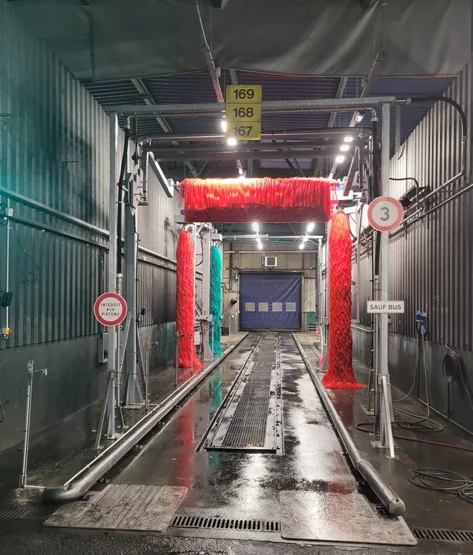
Wash cycle equipment
- Prewetting arches
- Side brushes
- Horizontal brushes for front and rear faces
- Medium pressure ramps
- Rinse
Wash adjusted to each row
Several modes of operation allow to adjust the quality of washing, rate and consumption according to the level of soiling of each row.
Controlled resources and energy
- Water filtration and recycling: fewer resources consumed
- High-efficiency engines: reduced energy expenditure
Supervision and telemaintenance
Intuitive supervision controls cycles, consumption and alarms. Thanks to the secure telemaintenance, our teams make a quick diagnosis and promote the continuity of your operation.
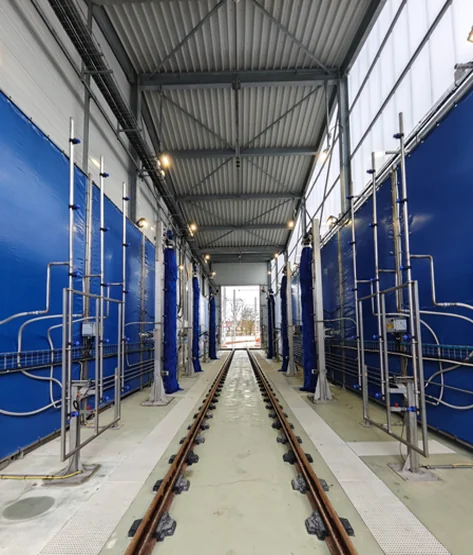
The MONTANIER Parade washer washes the chassis underside and bottom of your buses and trucks, while maintaining a high pace. It facilitates maintenance and prepares your vehicles for regulatory technical controls.
Technical specifications
- Cold water operation
- Flow rate: 300 L/min
- Pressure: 20 bar
- Flat-jet nozzles
Three fixed ramps, three treated areas
- 1 horizontal ramp: wash under chassis
- 2 vertical ramps: bottom and wheels
A pre-wash that protects the bodyshell
Installed upstream of a brush tunnel or portal, the washer removes the soil and the mineral or organic particles accumulated on the lower parts of the vehicle. These particles are removed before brush passage, which reduces the risk of scratches on the body and improves the quality of the final washing.
Designed for high speeds
Robust, the MONTANIER Chassis Washer ensures a powerful, homogeneous and fast washing without slowing down the passage of vehicles.
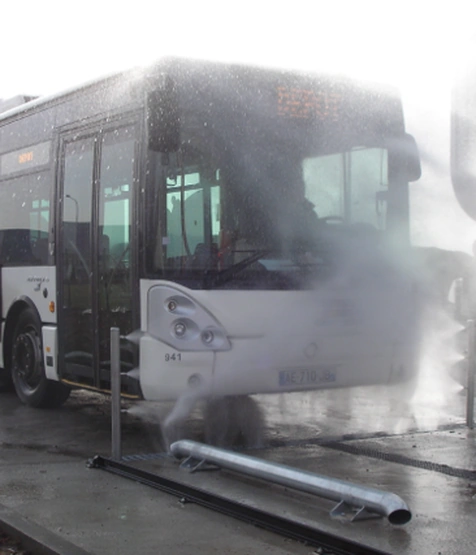
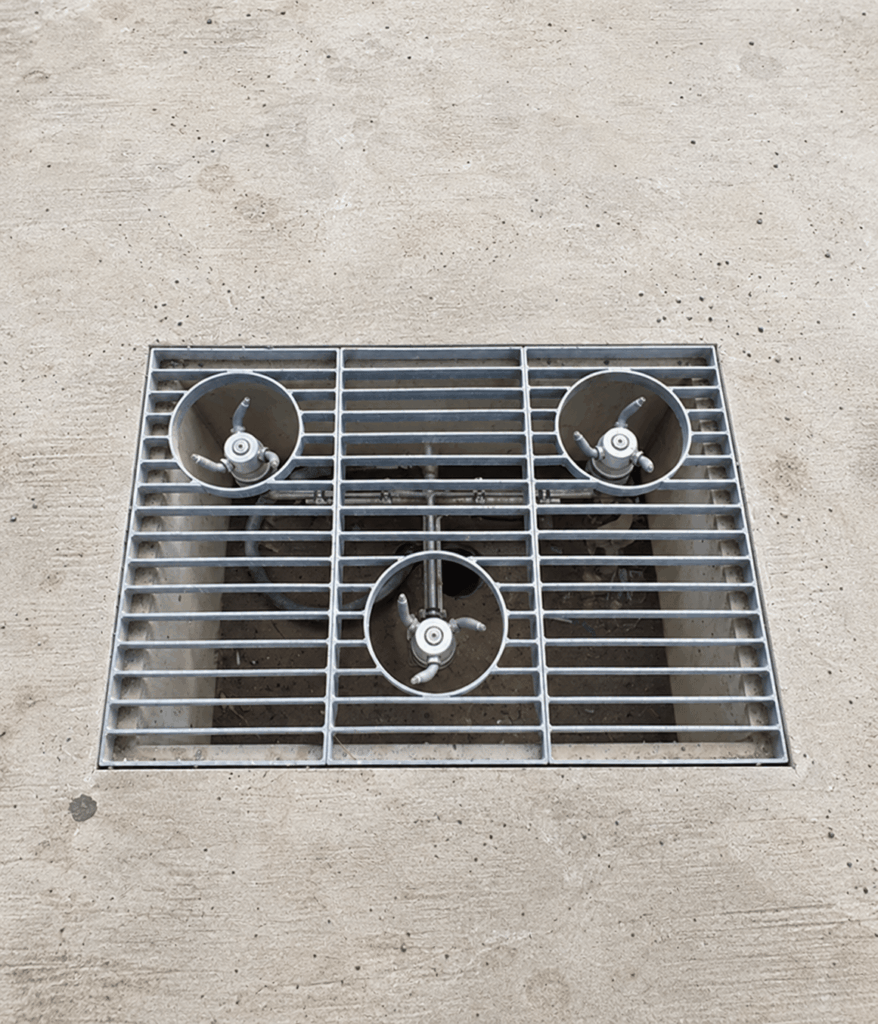
The MONTANIER Rotary Head Washer optimizes the chassis washing of your buses and trucks.
Three rotating heads in triangle
- 3 heads arranged in triangle, rotating at 360° around an axis
- Surface couverte : environ 2,20 × 2,00 m
- Résultat : un nettoyage puissant, homogène et rapide
Des jets qui nettoient sans abîmer
Les buses haute pression à jet plat décollent les salissures en évitant l’effet de « crayonnage ». La pression est répartie uniformément pour préserver les flexibles et les équipements sensibles situés sous le véhicule.
Une intégration simplifiée
Grâce à sa faible profondeur d’encastrement, le lave-châssis s’intègre facilement dans les installations existantes et facilite l’évacuation des eaux de lavage.
Une construction pour charges lourdes
- Cadre à sceller en acier galvanisé à chaud
- Caillebotis spécifiques charges lourdes, en acier galvanisé à chaud
- Résultat : robustesse, sécurité et longévité
En option : guide-roues
Une paire de guide-roues facilite le positionnement du véhicule et limite le risque de pincement des pneumatiques.
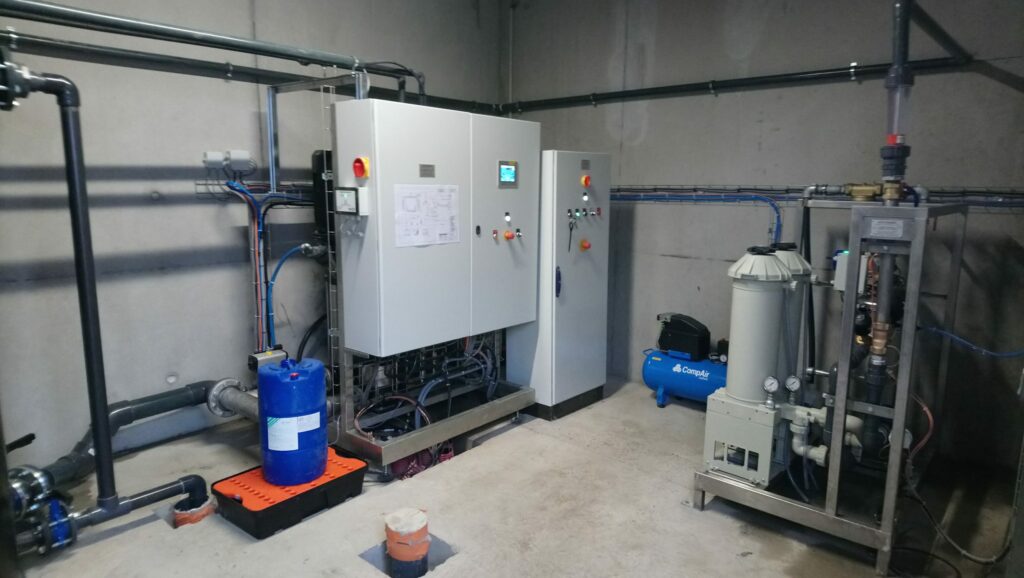
- Pre-treatment (entered): Implementation of a tank deburdening using the principle of settling. This principle consists of separating the solid phase from the liquid phase by difference in density and setting up a hydrocarbon separator.
- Secondary treatment (entered): Establishment of a 20m3 lift tank with aerobic biological reactor. The bioreactor contains microorganisms which, thanks to oxygen injection, consume dissolved pollution and develop. A recirculation pump, installed in the lift tank, allows the sludge to be recovered. Then she evacuates them into the mud tank.
- Tertiary (air) treatment: Skid filtration that improves the filter quality of recycled water. Once the water is filtered, it is discharged into a treated water storage buffer tank.